
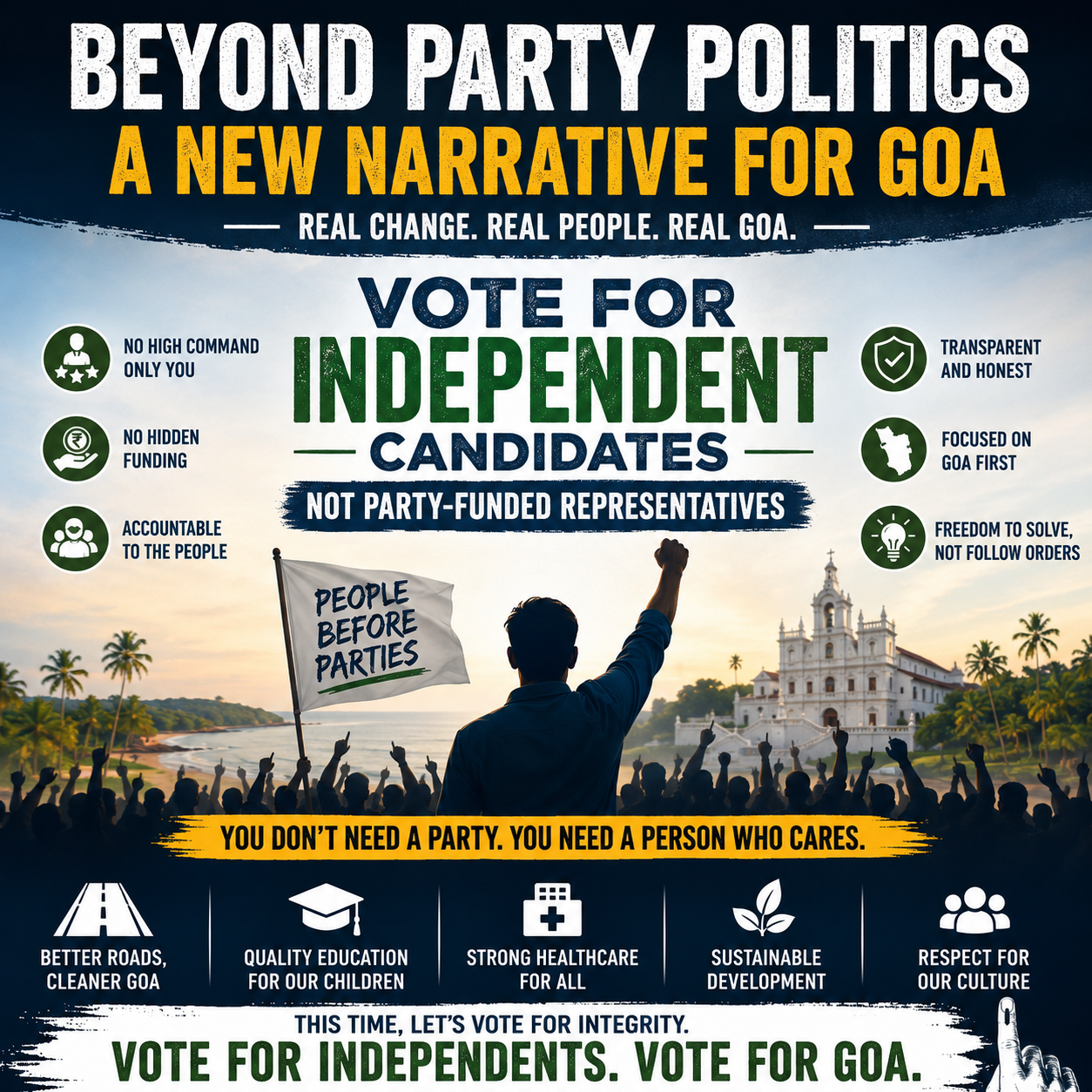
For decades, Goa has witnessed governments led by different political parties. Elections have come and gone, promises have been made, manifestos have been printed, and slogans have changed. Yet many citizens continue to ask the same question: if one party disappoints us, and the alternative eventually does the same, why do we keep repeating the same political choices?
Perhaps it is time to change not merely the government, but the way we think about governance itself.
Instead of asking whether the next government should be led by one major party or another, we should ask whether political parties themselves should remain the only path to power. Democracy gives people the freedom to elect individuals, not just party symbols. Independent candidates are as much a part of India's constitutional framework as candidates representing political parties.
Imagine a Goa where every constituency elects the most competent, honest, and accountable local representative, regardless of party affiliation. Imagine a Legislative Assembly made up primarily of independent voices whose first loyalty is to the people who elected them rather than to party leadership or political high commands.
This is not a call against any one political party. Rather, it is a call to rethink a system where party loyalty often appears to outweigh public interest. Governments of different political colours have each had opportunities to address issues such as infrastructure, education, healthcare, employment, environmental protection, corruption, and transparent governance. While progress has certainly been made in some areas, many Goans believe that persistent challenges remain and deserve stronger, more consistent solutions.
An Assembly dominated by capable independent representatives could encourage greater issue-based decision-making. Each proposal would need to stand on its own merit instead of being accepted or rejected simply because it originated from a particular party. Representatives would have stronger incentives to remain accountable to their own constituencies, knowing that their political future depends directly on public trust rather than party nominations.
Of course, such a model would also face challenges. Independent legislators would need to cooperate effectively, develop transparent methods of selecting leadership, and create stable governing arrangements. Without discipline and clear agreements, decision-making could become fragmented. Therefore, success would depend not merely on electing independents but on electing individuals of integrity, competence, and a demonstrated commitment to public service.
The real change begins with voters. Elections should no longer be contests between party colours but between character, competence, honesty, and vision. Citizens can ask difficult questions of every candidate: What have you contributed to your community? How will you remain accountable? Will you publish your work and spending transparently? Will you place the interests of Goa above personal ambition?
Goa has often led India by setting examples from literacy and civic participation to environmental awareness and local self-governance. Perhaps it can once again demonstrate that democracy is strongest when citizens think independently rather than voting out of habit.
Political parties will always have a place in democratic systems, but they should never become the only choice. Democracy belongs to the people, not to party offices. Every election presents an opportunity to renew that principle.
History is written by citizens willing to question old assumptions. If Goans believe the existing political narrative no longer serves their aspirations, they have every democratic right to imagine a different future. Whether that future is led by parties, independents, or a combination of both is ultimately for the electorate to decide.
The greatest strength of democracy is that power does not originate from political parties it originates from the people. When citizens vote thoughtfully, demand accountability, and choose candidates based on merit rather than labels, they reaffirm that governments exist to serve the public, not the other way around.
If Goa wishes to write a new chapter in its political history, the first step is not changing one party for another. It is changing the mindset that only political parties can govern. The true power has always belonged to the people. The ballot box remains the place where that power can shape a new narrative.